The plane that flew President Trump to Beijing on the night of May 13, 2026 carried about sixteen American executives. Their names are familiar. Elon Musk of Tesla and SpaceX. Tim Cook of Apple. Jensen Huang of Nvidia, added late, after a personal call from the president when the early invitation list went out without him. Larry Fink of BlackRock. Stephen Schwarzman of Blackstone. Jane Fraser of Citi. David Solomon of Goldman Sachs. Kelly Ortberg of Boeing. Larry Culp of GE. Dina Powell McCormick of Meta. Sanjay Mehrotra of Micron. Cristiano Amon of Qualcomm. The leaders of Mastercard, Visa, Illumina, and Coherent. Cisco's chief executive was invited and stayed home for earnings.
The president introduced them to President Xi as distinguished representatives of the American business community who respect and value China. The state-media account caught the room well. The summit's substantive output was thin: no agreement on the future of AI, an extension of an earlier truce on rare earths, a roughly $17 billion-a-year purchase commitment on American farm goods, and language about a constructive relationship. The reading that mattered most was not in the joint statement. It was in the passenger manifest. A presidential delegation is, among other things, a map of where economic and political power sits in a country at a given moment. The map had moved.
Why these names
Look at the list again and ask why these people and not others. The answer sits on a spreadsheet anyone can pull up. As of late May, Nvidia is worth about $5.2 trillion. Apple is at roughly $4.2 trillion. Combined, those two companies alone account for more than 40 percent of the entire Dow Jones Industrial Average by market capitalization. Tesla, also on the plane in the person of Elon Musk, is about $1.65 trillion. SpaceX, which Musk also runs and which is days from a public offering, carries a private valuation in the $1.25 to $1.75 trillion range. Just those four companies, Apple, Nvidia, Tesla, and SpaceX, have a combined market value of roughly $12 trillion, more than half the value of the entire thirty-company Dow.
Keep adding. Meta. Goldman. Visa. Mastercard. BlackRock. Blackstone. Boeing. Citi. GE. Micron. Qualcomm. The total market value represented on that single plane comfortably exceeded $16 trillion. The Dow itself, the index Americans treat as a kind of shorthand for the national economy, is worth somewhere around $23 trillion. The people in that cabin held, by the most natural reading of the Dow as an institution, the rough equivalent of seventy percent of it.
This is what the locus of power looks like when you can take a photograph of it.
The change in the power dynamic
That photograph has a precedent, and the comparison is the argument. The last sitting American president to visit China was Donald Trump himself, in November 2017, on his first trip to Beijing. He brought a business delegation then too, larger than this one, twenty-nine companies. The names tell the story of an earlier America. General Electric. Honeywell. Boeing. Energy and commodities firms. Heavy industry. The mission was led by the Commerce Secretary. Tech and finance were largely absent. Industry reporting at the time noted that tech firms were reluctant to go, citing market-access concerns and the unpredictability of the trade environment.
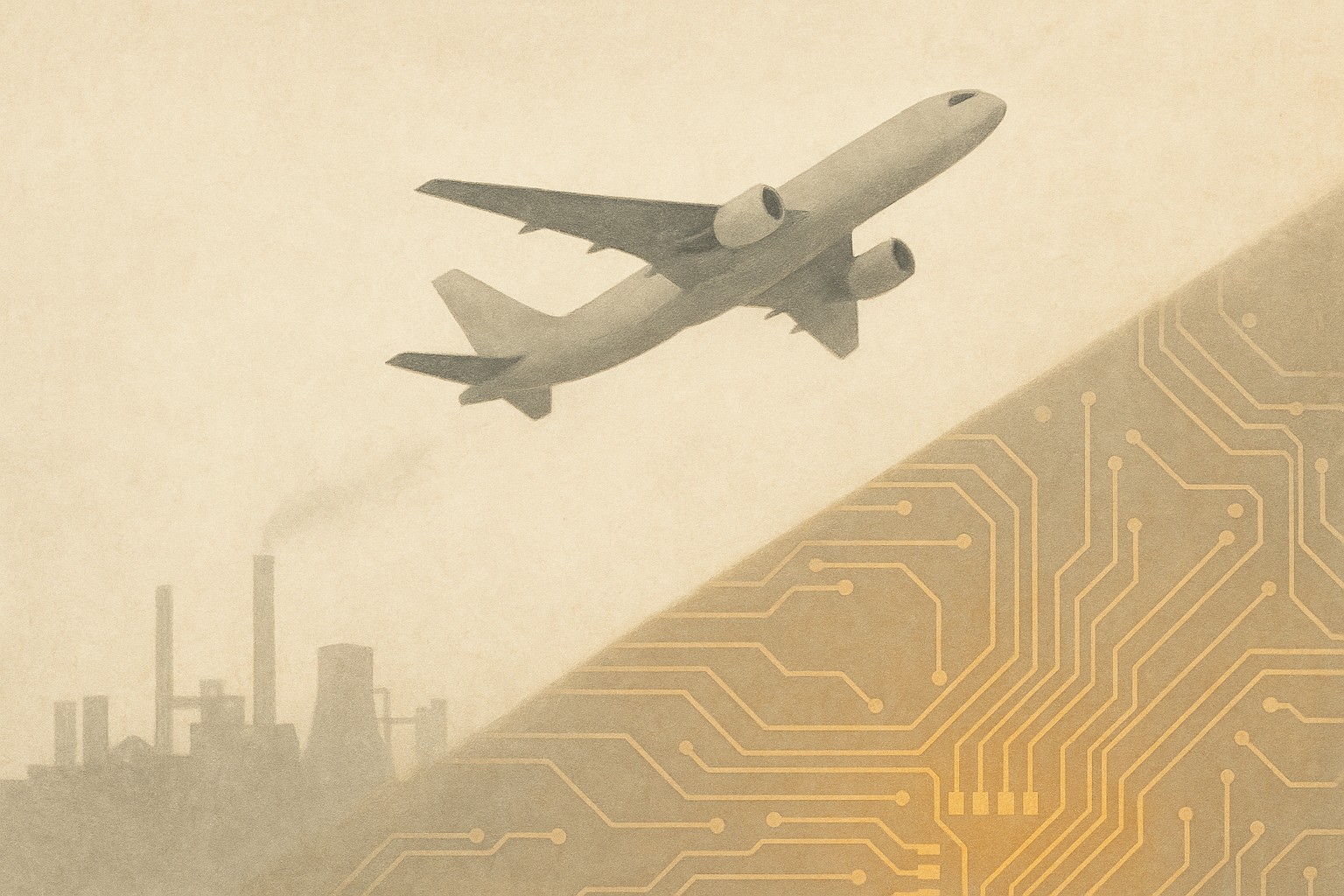
Eight years later the same president flew the same route on the same kind of aircraft. The composition of the cabin changed completely. The smokestacks gave way to the chips, the platforms, and the trading desks. The Commerce Secretary stayed home. A Chinese state-media analyst pointed out, approvingly, that the 2026 delegation included far more high-tech and financial firms than 2017. He was not wrong.
That is what the change in the locus of power looks like when measured in passenger seats. The shift was not gradual. It was visible on the manifest.
Who was speaking for whom
The manifest of a foreign trip is also a statement about how absent constituencies are represented. The constituency with the most direct exposure to a US-China deal is American farmers, and especially soybean growers. Soybeans are the largest single agricultural export from the United States. China has historically bought roughly half of that crop. During the trade war the administration reopened in 2025, Chinese purchases of the new American soybean harvest fell to zero. Beijing bought from Brazil and Argentina instead. The damage was concrete. Farmers, like the rest of us, do not get paid in narrative.
The summit produced a real agricultural deal: at least $17 billion a year in American farm goods through 2028, restored access for U.S. beef and poultry, and soybean purchases of twelve million metric tons this year and twenty-five million tons annually after. The U.S. Trade Representative could not give specifics on the spot and used the phrase "double-digit billions." Farm groups called the news encouraging and asked for more. The deal is, on its face, a partial restoration of a market the trade war destroyed.
Notice the form of representation. Farm interests were spoken for by the Agriculture Secretary, who is a cabinet officer and was not on the plane. The deal was announced from a podium in Washington. The technology and finance firms in the cabin were not spoken for. Their CEOs were there, in person, sitting with the head of state, available to be asked what they needed and to answer for themselves. That asymmetry is not a slight on the cabinet secretary. It is a structure. Trade exposure was met with a proxy at home. Corporate exposure was met with personal access abroad. The farmers were playing defense by proxy, recovering ground a trade war destroyed. The executives were playing offense in person, there to win something new.
The same room at home
The change in where power sits is also being written into the federal rulebook at home. The same firms gain ground; the people exposed to their systems lose it.
In April 2025 the White House issued Executive Order 14281, directing federal civil rights agencies to deprioritize the use of disparate-impact analysis. In January 2026 the Department of Housing and Urban Development proposed rescinding its disparate-impact regulation under the Fair Housing Act, the framework that lets discriminatory effects, including those produced by algorithms, be challenged without proof of intent. Those two actions, taken together, remove from the federal toolkit the principal mechanism by which an ordinary person can meaningfully challenge a hiring algorithm that quietly screens them out, an underwriting model that systematically undervalues their neighborhood, or a benefits algorithm that flags them for fraud they did not commit. The stated justification has been the same throughout: removing obstacles to American competitiveness, to the firms building these systems, to winning the race against China.
That is the policy. Here is what it does to one ordinary person. Derek Mobley applied to more than a hundred jobs through Workday over seven years and got rejected by every one of them, sometimes within an hour of submitting, sometimes at 1:50 in the morning. We covered the case at the human scale in How a Hiring Algorithm Actually Decides. The line that landed it: "A computer did." The legal hinge is what matters here. The doctrine letting Mr. Mobley's case advance is disparate impact, the same doctrine the April order tells federal agencies to deprioritize. Take that doctrine away, and the door closes on this case and the ones behind it.
This is what it means to say the locus of power moved. The owners of these systems have personal access at the highest level. They are flown to summits, introduced to heads of state, asked what they need. The people the systems are used on have something else now. They have a federal posture in which the legal language of their recourse is being struck from the books, while the firms whose access they would have used that recourse against are sitting in the cabin and being asked what they would like opened next.
If the Beijing trip was the foreign-policy expression of who counts now, the disparate-impact rollback is the domestic expression. The seating chart and the rulebook agree.
Who has the right to be in the room
None of this is, by itself, an argument against trade or AI or the firms on the plane. Soybean farmers are better off after the deal than they were before it. The companies in that cabin make products and run platforms hundreds of millions of Americans use every day. The country needs an AI policy and the strategic competition with China is real.
The argument is narrower and harder to dismiss. It is about who has the right to be in the room when decisions like these get made. In Beijing, technology and finance firms had their principals in the cabin, alongside the head of state. American agriculture was spoken for by a cabinet officer who was not on the plane, who announced the deal from a podium back home. The president, by his office, represented the American public. The principals in the cabin represented something narrower: their firms' particular interests in China.
Those interests have changed in eight years. The 2017 delegation spoke for industries with broadly distributed exposure: soybeans, jet engines, energy. The 2026 delegation came to press a different and more concentrated set of concerns: chip export licenses for Nvidia and others, supply chains running through Taiwan, market access for platforms restricted from operating in China, and the ability to keep doing business under whatever sanctions regime comes next. These are firms with specific asks, pressed by the people best positioned to press them. There is a hierarchy of access in that photograph, and the same hierarchy is being written into the federal rulebook at home.
That hierarchy is not an interpretation. It is a description. Equity & AI exists to track these patterns and to inform the people they affect. That work continues.