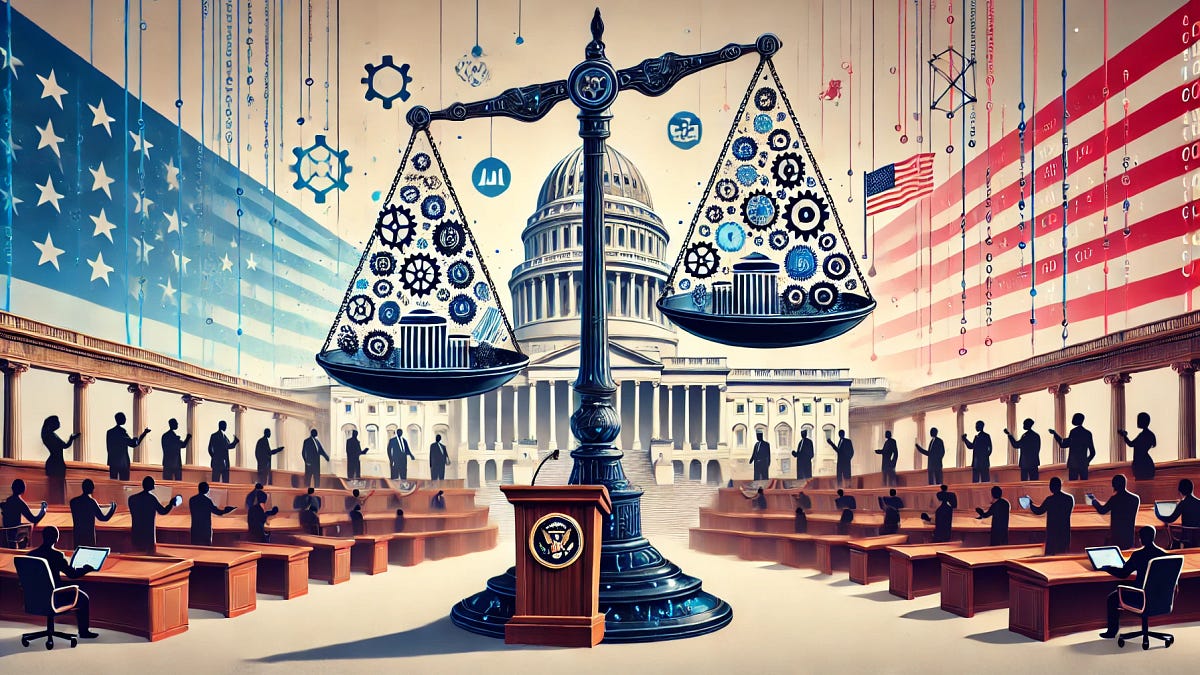
Biden’s AI Protections Revoked: Trump’s New Executive Order and the Future of AI Equity

Biden’s AI order prioritized fairness, but Trump’s policy removes oversight for rapid innovation. What does this mean for AI equity and U.S. leadership?

AI policyAI equityregulationalgorithmic discriminationU.S.
Ernest McCaleb··6 min read
Cover: Biden’s AI Protections Revoked: Trump’s New Executive Order and the Future of AI Equity

Trump’s AI Policy is Still Unfolding

I wanted to publish this blog weeks ago, but the pace of change in AI policy has been dizzying. It’s like trying to solve a puzzle while someone keeps adding new pieces. Every time I thought I had a clear picture, another development forced me to reevaluate my thoughts. Trump’s executive order marks the beginning of a fast-moving and highly consequential shift in how AI is governed.

President Donald Trump’s "Removing Barriers to American Leadership in Artificial Intelligence" executive order has already reshaped the AI landscape, revoking key protections from Biden’s AI policy and shifting the focus toward deregulation and rapid innovation.

But this isn’t the full story—Trump’s order requires the development of a new AI action plan within 180 days. That means we don’t yet know what his alternative AI strategy will look like.

While some argue—and I agree—that deregulation will spur innovation, many are deeply concerned about the loss of fairness and accountability measures. For now, here’s what has been removed—and why it matters for real people.

What Has Been Revoked? The AI Equity Protections That Are Now Gone

1. AI Bias & Civil Rights Protections

  • Before: Biden’s executive order required federal agencies to address algorithmic discrimination —when AI systems unfairly favor or harm certain groups of people—in hiring, lending, healthcare, and policing.
  • Now: There is no federal oversight ensuring AI fairness. Imagine a recent college graduate applying for their first job. Under Biden’s policy, the AI hiring tool they interact with would have been tested for bias. Now, that same tool might reject their application because of their name, which suggests a particular ethnicity—and no one would ever know why.

2. AI Transparency & Accountability

  • Before: Companies developing advanced AI models had to share safety test results with the government and undergo third-party audits (independent reviews) for bias.
  • Now: There are no required AI safety reports or external fairness audits. Think about a small business owner applying for a loan. Under Biden’s rules, the AI system deciding their fate would have been tested for fairness. Now, that system could charge them higher interest rates based on flawed data—and no one would be there to catch the mistake.

3. AI in the Federal Workforce

  • Before: Government agencies had to review AI’s impact on marginalized communities before deploying AI-driven decision-making tools.
  • Now: AI tools used for hiring, public benefits, and law enforcement no longer need equity reviews. Picture a veteran applying for disability benefits. Under Biden’s policy, the AI system processing their claim would have been checked for bias. Now, that system might deny them the support they deserve—simply because the algorithm wasn’t designed to understand their unique circumstances.

4. AI & Consumer Protection

  • Before: The Consumer Financial Protection Bureau (CFPB) was tasked with monitoring AI-driven lending to prevent racial and economic discrimination . For example, if an AI system unfairly denied loans to people of color, the CFPB could step in and hold the company accountable.
  • Now: The Trump administration has effectively dismantled the CFPB , halting its operations and leaving no federal agency to oversee AI-powered financial systems. This means AI-driven lending, credit scoring, and insurance models can operate with no federal scrutiny at all . Imagine a young couple trying to buy their first home. Under Biden’s rules, the AI system evaluating their mortgage application would have been monitored for fairness. Now, that system might reject them because of their race or neighborhood—and there’s no agency left to protect them.

The Government’s AI Problem: A Firsthand Perspective

Having worked for a venture-backed startup trying to bring AI solutions to the government, I’ve experienced firsthand how difficult it is to navigate the government’s regulatory hurdles, compliance barriers, and risk-averse culture . Unlike the private sector, where innovation thrives on efficiency and results, government agencies often prioritize bureaucratic processes over technological progress .

AI is a tough sell in government because many decision-makers are more focused on ticking compliance boxes than leveraging AI for real-world outcomes. This creates a paradox: while the government funds commercial AI innovation , it struggles to adopt the very technology it promotes.

I even took this issue directly to Capitol Hill a few months back , joining a lobbyist group focused on AI and defense initiatives for the Department of Defense . Over multiple sessions with representatives for various congressmen and congresswomen, we pressed them on how Biden’s AI plan would be enforced, validated, or adjudicated —but no one could provide a clear answer. They struggled to articulate how AI fairness would be regulated in practice, beyond broad policy statements.

If Trump’s AI roadmap includes streamlining AI adoption in federal agencies, it could be a game-changer for government efficiency. However, if deregulation simply means handing AI leadership over to private companies , the government may fall even further behind in its own AI adoption.

Operational Timeline: What We Know So Far

Phase 1: Executive Order Implementation (Days 1-30)

✅ Executive Order Signed – Trump’s order revokes key AI protections from Biden’s policy and directs federal agencies to review existing AI regulations. ✅ Federal Agency Review Begins – Agencies like the Department of Defense (DoD) , National Institute of Standards and Technology (NIST) , and the Department of Commerce start assessing which AI regulations will be removed or revised. ✅ Industry Response – Major tech companies and defense contractors begin preparing for potential changes in AI oversight and regulation.

Phase 2: Development of the AI Action Plan (Days 31-180)

✅ Drafting the Roadmap – Federal agencies are required to develop a new AI action plan within 180 days, as outlined in Trump’s executive order. ✅ Stakeholder Input – The order calls for collaboration with private sector leaders, though the specifics of these meetings are not yet public. ✅ Global Context – While the U.S. reevaluates its AI policies, other countries like China and members of the EU continue advancing their own AI regulations and innovations.

What’s Next?

The next six months will be pivotal in shaping the future of AI governance in the U.S. While we don’t yet know the details of Trump’s AI action plan, we do know that:

  • Fairness protections have been removed , leaving gaps in oversight for AI bias, transparency, and accountability.
  • Federal agencies are working on a new roadmap , which will determine whether equity and accountability are prioritized or sidelined.

Final Thought: It’s Not Just About What’s Gone—It’s About What Comes Next

Right now, AI fairness protections are weaker than they were under Biden —but the story isn’t over yet. Trump’s AI policy will take shape over the next 180 days. The question is: Will it address AI equity, or will it leave fairness behind?

🚀 The next six months will determine the future of AI accountability. The time to push for fairness is now.

I’ll keep you informed as Trump’s AI policy takes shape, providing updates on what it means for equity, innovation, and the future of AI in the U.S. Stay tuned—this conversation is just getting started.

Join the Conversation

🚀 How can we hold AI systems accountable in a deregulated environment? 🚀 What will AI equity look like in a deregulated landscape? 🚀 Can we innovate rapidly without sacrificing fairness?

Let’s discuss.

🔹 #AIEquity 🔹 #ArtificialIntelligence 🔹 #AIRegulation 🔹 #TrumpAI 🔹 #AIInnovation 🔹 #EthicalAI 🔹 #TechForGood 🔹 #AITransparency 🔹 #OpenSourceAI